

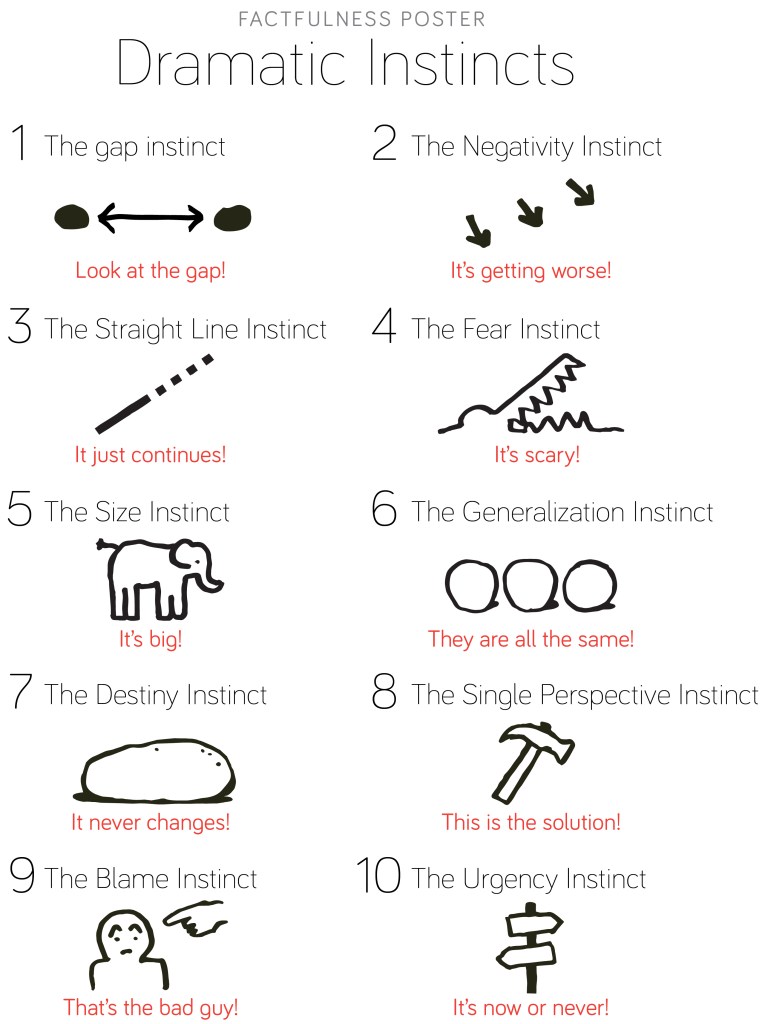
Humans have a tendency to dramatise.
Can we as IT professionals — from the CIO to the project manager to the IT technician — overcome these dramatic instincts?
Are we even aware of what these dramatic instincts are?
Fortunately, the late Hans Rosling had an idea (or 10).
Wikipedia | Obituary
1. The Gap Instinct – “Us vs Them”
Have you ever come across organisations where the CIOs or IT departments are seen as the “evil empire” relative to the business units? This gap mentality leads to underinvestment in IT–business integration initiatives, turf wars, and finger pointing rather than collaboration.
- Queensland Health payroll debacle: mis-payments to 78,000 staff over 18 months, caused in part by poor communication between central IT/government executives and the health departments.
- Statewide Health Department: I’ve lived this first-hand. Business saw IT as a black box. Only when we embedded joint governance did we turn the tide, delivering an integrated financial system that recovered $60M a year
2. The Negativity Instinct – “Bad News Dominates”
Overreacting to early warnings or failures whilst ignoring cumulative progress can derail the long-term roadmap.
- Case study: In “Why IT projects still fail,” the authors note many aligned, progressing programs collapse because leadership is hypersensitive to negative signals. Read the article here CIO.
- Major Australian Airport: During a $7.1M network refresh, dozens of “issues” were flagged. Ninety percent were trivial. Had we escalated every one, executives would have pulled the plug. Instead, zero downtime and $2.8M in SLAs were secured
3. The Straight Line Instinct – “Trends Don’t Bend”
We love assuming usage or adoption will grow linearly. Reality? Growth plateaus, bends, or reverses.
- Public sector IT studies: Broad cloud migrations and ERP rollouts often assume smooth curves, but plateau quickly. For example see the public sector IT risk studies by Flyvbjerg/Budzier in arXiv+1.
- Major WA Miner: Migrating Automated Haulage Trucks from Wi-Fi to LTE cut outages by 70% and delivered $15M/year in productivity gains. But adoption wasn’t linear: one site sprinted, another limped.
4. The Fear Instinct – “Scary Beats Likely”
Fear causes executives to overinvest in worst-case scenarios or make reactive decisions.
- A Fast Company article highlights fear-induced mistakes: including micromanagement and decision paralysis. See article here Fast Company
- A major WA financial services organisation: Headlines screamed “cyber Armageddon.” The likely risk? Uncontrolled file sharing. We quietly deployed DLP/MIP, avoiding regulatory exposure of >$1M.
5. The Size Instinct – “Big Numbers Lack Proportion”
Big numbers dazzle us, but lack context. Our being dazzled by big numbers can cause us to make extreme decisions (e.g. scrapping programs).
- Flyvbjerg/Budzier IT risk papers: average cost overrun is 27%, but a few blowouts skew the picture. Many executives are misled by average figures and miss the extreme risk. See article here: arXiv.
- Major WA Miner: A stakeholder panicked over a “$15M loss.” Context: that’s daily iron ore revenue. The LTE comms upgrade saved exactly that — every year.
6. The Generalisation Instinct – “One Group = All”
Executives assume one group = the whole.
- Finkelstein’s “Why Smart Executives Fail”: leaders force-fit past patterns. This article shows how leaders overgeneralize patterns that worked in one context and forcibly apply them elsewhere. See here mba.tuck.dartmouth.edu
- Major WA Miner: Same mining company, same vendor, same SD-WAN rollout. One site thrived; another resisted. Treating “miners” as one group would’ve sunk us.
7. The Destiny Instinct – “Things Never Change”
Believing that things never change prevents transformation.
- Kodak/Blockbuster are textbook failures. Firms fail because they stick to past models even as the environment changes (e.g. Kodak, Blockbuster). That is a form of destiny thinking. Check the source trap here: Wikipedia.
- Statewide health department: Executives once said “finance here will never modernise.” Then we built an integrated system that saved $60M/year.
8. The Single Solution Instinct – “One Fix for All”
Silver bullets tempt executives: “Just go Agile. Just go Cloud. Just go A.I.”
- Postmortems often show mixed approaches work best. Overcommitting to a single technology or methodology is a result of the Single Solution Instinct (“One fix for all”) ignoring that different systems or domains may require distinct architectures or approaches.
- Major Australian manufacturer: Instead of “one ERP to rule them all,” hybrid vendor models saved $5M.
9. The Blame Instinct – “Villains Everywhere”
When things go wrong, we look for scapegoats instead of systems.
- For example in “10 steps to turn a failed project into an opportunity,” one advice is “avoid the blame game; do a root-cause analysis.” The very fact that this is recommended shows blame is a frequent misstep according to CIO magazine.
- A Federal SAP Program that I ran was turned around only after governance was fixed, not after blaming individuals.
10. The Urgency Instinct – “Now or Never”
The pressure to “go live now” derails quality.
- Queensland Health payroll: In the Queensland Health payroll project, go-live happened despite known defects and inadequate testing — a rush to meet a deadline rather than gradual rollout. See case study here: Wikipedia.
- Major WA Miner: Execs once pushed “it must be live by Christmas.” I fought back; better to delay than wear a $20M/year loss. The instinct to skip or compress essential steps (governance, testing, change management) to satisfy artificial deadlines, which then backfires.
Antidote: Rules of Thumb
But there is an antidote to these dramatic instincts: Rules of Thumb.
Check our Factfulness Part Two – Rules of Thumb article to find out more…
Final Reflection. The late Hans Rosling deserves the final words, “the first thing we must do is realise our own ignorance.”
“When decisions are driven by misconceptions, opportunities for meaningful change are missed. The root problem is ignorance about ignorance. Most people are unaware of their own misunderstandings, so they cannot correct them.”

 SquaringTheTriangle
Join the conversation — how do you Square the Triangle?