
Why Basketball Coaches Make the Best Project Managers

INTRODUCTION
After 30+ years of portfolio, program and project management, it felt good to encounter a new discipline that brought fresh perspectives and give me new insights on how to lead great and successful winning teams. That discipline was as a basketball coach. Five years on and the lessons keep coming and the parallels get stronger and stronger.
- What happens if you are down a team member?
- What happens if opposition resistance is stronger than you thought?
- What happens when the deadline won’t get extended?
SUMMARY
In Australia basketball has risen to new heights. It has surged from a niche pastime to a national powerhouse, now boasting over 1.3 million players annually and record-breaking NBL attendance topping 1.1 million.
Likewise, the rise of the project management industry in Australia is unparalleled. Project management has evolved to having nearly 387,000 Australians now employed across core PM roles including Contract, Program & Project Administrators (164,900), Construction Managers (130,500), and ICT Managers (91,500), driving professionals and managers are predicted to represent over 40% of the workforce by 2033.
What once were specialized fields have become essential pillars of Australian sport and business, each demanding the same strategic thinking, team coordination, and execution under pressure that make basketball coaches natural project management leaders.
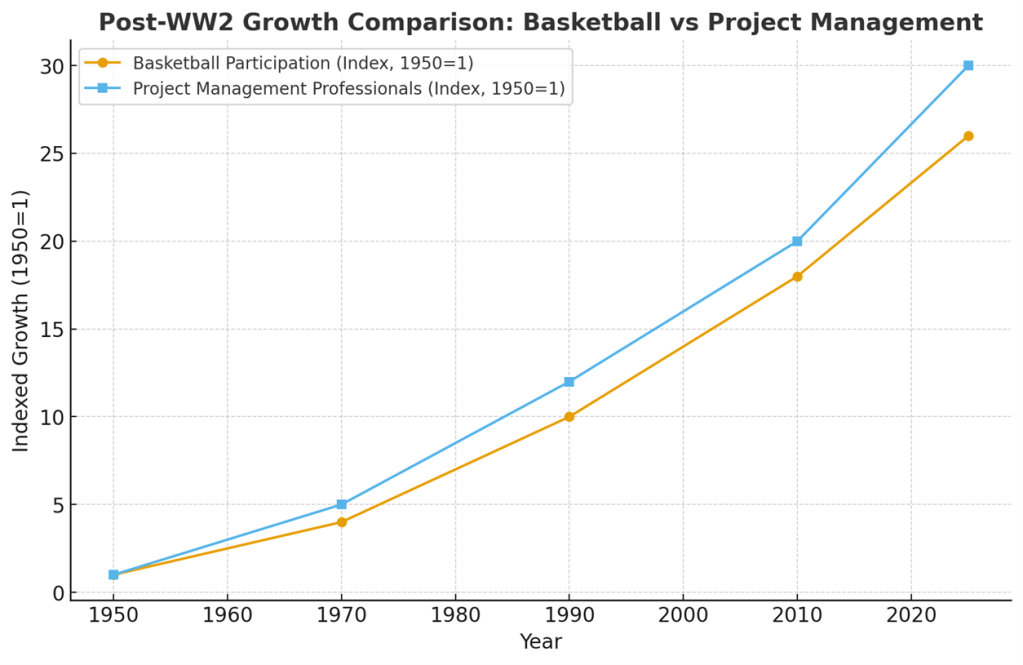
Key Sources
- Basketball Australia. Annual Report 2023. Published 2024. Melbourne: Basketball Australia.
- Project Management Institute (PMI). Talent Gap Report 2025. Published 2025. Newtown Square, PA: Project Management Institute.
But both industries have much more in common than explosive growth. Here are some common comparisons.

COMPARISON 1
Project teams, much like basketball squads, go through their own season arc—a process first described by psychologist Bruce Tuckman in 1965.
Forming is the preseason camp: lots of handshakes, name learning, and lineup experiments as everyone figures out where they fit.
Storming resembles those first scrimmages, when enthusiasm collides with reality: debates over “shot selection” (priorities), missed defensive rotations (missed deadlines), and a few players angling for more minutes (visibility).
Norming, the season is underway and the rhythm builds—leaders emerge, plays are run with fewer hiccups, and even the bench buys into the system.
Finally comes Performing, the playoff push—where the team clicks instinctively, trust is high, and under pressure they execute like they’ve been doing it forever.
Comparison 1 – Tuckman’s Stages
Forming, Storming, Norming, Performing → preseason to playoffs.
Lessons for PMs:
- Treat early project phases like preseason — expect mistakes and allow experimentation.
- Lean into retrospectives when storming hits; conflict is normal, alignment is earned.
- Celebrate when the team reaches “performing” — but don’t assume it stays there automatically.
COMPARISON 2
In both basketball and project management, the scoreboard doesn’t always tell the full story.
“Learn to Lose” isn’t about accepting defeat — but it is about transforming that loss into fuel for growth. Just like a team huddles around the coach to understand blown coverages and missed opportunities, project teams must review their own missteps with “courage, curiosity, and care” not condemnation. Failure isn’t a red card — it’s an opportunity for growth.
Project management is no different. A missed deadline, a budget overrun, or a scope misstep shouldn’t be treated as a catastrophe — it’s time for a retrospective and a review.
This links directly to the popular mantra “fail, fail fast, fail better.” Originally popularised in literary form by Samuel Beckett but now firmly embedded in both defence and business contexts, the idea has been embraced from British Army training campaigns (“Fail. Learn. Win.”; “First Time Fails”) to MoD cyber resilience strategies, and even Parliamentary debates on AI adoption. The message is consistent: “failure is not shameful — it’s a tool”.
Comparison 2 – Learning from Failure
“Fail, fail fast, fail better” → resilience in action.
Lessons for PMs:
- Normalise failure reviews: frame them as coaching huddles, not blame sessions.
- Use quick post-mortems to capture lessons while they’re fresh.
- Translate setbacks into specific process tweaks — don’t just file them away.
COMPARISON 3
The table below shows how everyday basketball disciplines—like wearing the right uniform, arriving on time, or high-fiving teammates—translate directly into equivalent practices in project management.
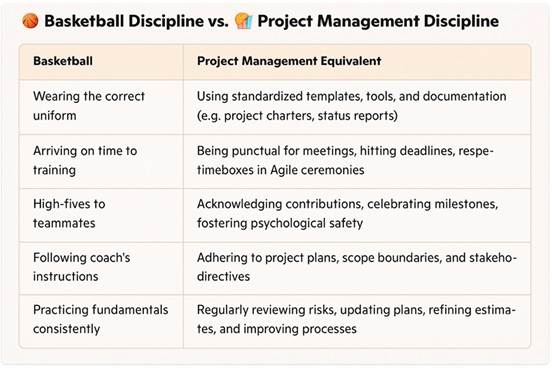
Good discipline practices and good discipline practices whichever industry they are applied to.
Comparison 3 – Discipline
Uniforms, punctuality, and rituals translate into delivery discipline.
Lessons for PMs:
- Small rituals (start on time, finish on time) signal professionalism.
- Shared behaviours build culture faster than big speeches.
- Model discipline as a leader — teams copy what they see.
COMPARISON 4
We mentioned the “huddle” earlier in comparison 2, well what about the “huddle”? How is that remotely like project management?
The huddle is a ritual of recalibration. In basketball, it’s about syncing players before the next move.
The key similarity is that both are about rapid synchronization – making sure everyone knows what’s happening right now and what needs to happen next. Neither is the place for long discussions or detailed problem-solving; they are about quick re-alignment so the real work can happen effectively.
Both also create that sense of “we’re in this together” team unity. It is also a signal. Just like a huddle shows the team is locked in, a well-run stand-up or retrospective signals a team that’s disciplined, communicative, and resilient.
In project management, it’s about creating space for clarity, accountability, and cohesion — especially when things get difficult.
Comparison 4 – The Huddle
Basketball huddle ↔ project stand-up.
Lessons for PMs:
- Keep stand-ups short and focused on “what’s next.”
- Use them to re-synch, not to solve everything.
- Make it a signal: disciplined teams check in, even under pressure.
COMPARISON 5
A fifth comparison is the value of a sports psychologist in basketball or any sport. They’re as vital as the coach or the playbook. Mindset and motivation are treated as the engine of performance.
In project management, the same mental component exists. However it often gets brushed off as “soft skills” when in reality it’s the hardest thing to master.
Mental resilience on the court? Breathing through a turnover, reframing a missed shot—is mirrored in retrospectives and workshop sessions where PMs help teams reset after setbacks.
Focus and flow? Athletes zero in on the next play; project teams thrive when they lock onto the next milestone instead of drowning in the full roadmap.
Managing pressure? Confidence building through weekly practices becomes capability uplift for the project manager through coaching, mentoring and recognition.
Whether it’s a buzzer-beater or a Friday 5 p.m. deliverable, performance of both basketball teams and project teams all hinges on how well the mind handles the moment.
Comparison 5 – Psychology & Resilience
“Soft skills” are actually the hardest.
Lessons for PMs:
- Build resilience by normalising resets (pause, breathe, reframe).
- Encourage focus on the “next milestone” rather than the full daunting roadmap.
- Recognise small wins — confidence compounds like momentum in a game.
COMPARISON 6
For a final comparison lets take the “Iron Triangle” of project management—Scope, Cost, and Schedule and treat them as the basketball equivalent of Offense, Defense, and Transition.
Scope is your offensive playbook: bold, ambitious, and full of dazzling moves that wow stakeholders. Cost is your defense—tight, disciplined, and constantly trying to block budget overruns from dunking on your bottom line.
And Schedule? That’s transition: the chaotic sprint between planning and execution, where timing is everything and one misstep can turn a fast break into a faceplant.
Just like in basketball, balancing all three is the difference between a title-winning season and getting benched by your client. 🏀
Comparison 6 – The Iron Triangle
Scope = Offense, Cost = Defense, Schedule = Transition.
Lessons for PMs:
- Don’t chase all three at once — make conscious trade-offs.
- Communicate which corner of the triangle is the current priority.
- When pressure builds, simplify: what’s the one “play” that must succeed?
CONCLUSION
And so there you have it. Basketball coaching is close to project management than you may have ever thought. Although there is one major difference …
If all else fails, wouldn’t it be great to get our teams to hit the deck and do ten push-ups!….

 SquaringTheTriangle
Join the conversation — how do you Square the Triangle?