

Setting the scene
Have you ever been across the Brooklyn Bridge?
Or flown in through Denver?
Or visited the Sydney Opera House?
If so, you were experiencing the results of a megaproject and one that had failed in its original intent.
The Brooklyn Bridge was completed 100% over budget.
Denver International Airport was completed 200% over budget.
And the Sydney Opera House was
completed a whopping 1,400% over budget.
(As an aside, imagine reporting the CPI (Cost-Performance Index) to your management – 0.1, -0.2 and 0.07 !!!)
These are not isolated examples.
The Iron Law
Megaprojects have a poor success record. So poor, in fact, that Oxford researchers couldn’t find enough successful projects to form a valid control group.
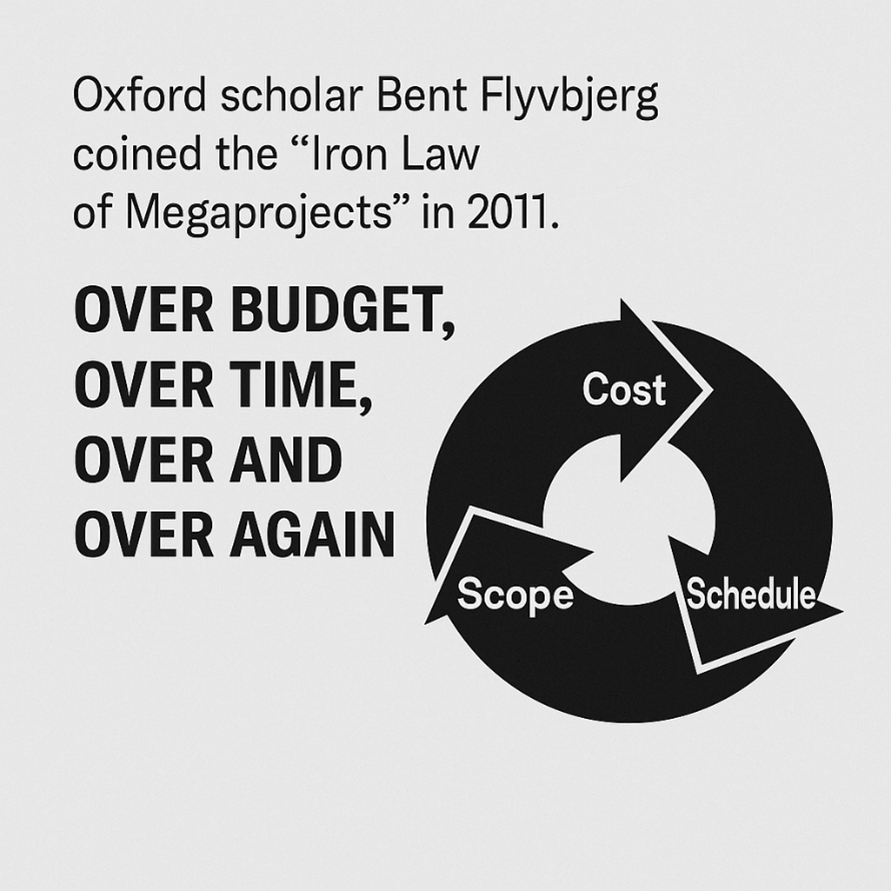
The Iron Law of megaprojects was developed in 2011 by one of those same Oxford scholars, Bent Fyvbjerg. It deliberately echoes the Iron Triangle of Cost, Scope and Schedule from project management, but this time with a simple cadence and malevolent outcome:
“over budget, over time, over and over again”.
Beyond the Iron Triangle
Researchers such as from Williams (2016) are moving away from the constraints of the Iron Triangle and now emphasize that the nature of project success is
multidimensional with different criteria, only some of which are clearly
measurable. Indeed, the urgency is so great that academic–practitioner workshops and international forums are increasingly focusing on megaproject resilience.
It is this outpouring of research, with practitioners and academics working together, that gives hope to managing the challenges these projects present.
Lessons from Research
In a seminal 2017 article, for example, Aaron Shenhar and Vered Holzmann researched 14 megaprojects and isolated their critical success factors.
The 3 success criteria identified were:
1. Clear strategic vision
Think of Kennedy’s vision to put “a man on the Moon and bring him back before the end of the
Decade”. Contrast this with the lack of specific vision for the NASA Space Shuttle program;
2. Total alignment
That is full alignment of all parties with the goals, the means, and the difficulties expected).
Think of the 2012 London Olympics (known as the austerity Olympics, coming after the global financial crisis) where managers, planners and contractors used a common set of rules and risk-sharing agreements to align with the vision. Contrast this with the arguments and politicking involved in the building of the Sydney Opera House.
3. Adapting to complexity
Think of the Guggenheim Museum in Bilbao, a building nearly as iconic as the Sydney Opera House — delivered on-time and on budget. Contrast this, the researchers suggested, with Boeing’s 787 Dreamliner program, involving new materials, new business models and a new organisation.
What This Means for Today
With infrastructure spending on the increase, and especially in the emerging world, this simple yet effective model will help more megaprojects as they get underway.
Call to Action: Join the Global Megaproject Conversation
If the “Iron Law” is to be broken, it won’t happen in isolation. Progress comes when researchers, practitioners, and leaders connect, debate, and share lessons across borders. Here are three forums you can join to stay at the forefront:
MeRIT Workshop Series (Italy)
A multidisciplinary, research-driven workshop exploring complexity, sustainability, and innovation in megaprojects.
🔗 Learn more and see upcoming editions
IPMA Megaprojects Special Interest Group (SIG)
A global practitioner network under the International Project Management Association, offering workshops, case studies, and shared best practices.
🔗 Join the IPMA Megaprojects SIG
International Megaprojects “Theory Meets Practice” Workshop (historic series)
While the last confirmed edition was in 2023, this influential workshop series (since 2012) remains a touchstone in the field.
🔗 Background and history of the workshop
Whether you’re managing a city-shaping project or studying the forces behind them, these forums are where the cutting edge of megaproject thinking lives. Join the conversation—and help prove the Iron Law wrong.
Conclusion
The Iron Law tells us megaprojects are doomed to fail. But history shows they don’t have to. By anchoring vision, aligning every stakeholder, and embracing complexity rather than fighting it, we can rewrite the ending.
The next time someone says ‘over budget, over time, over and over again,’ project leaders should counter with proof that it doesn’t have to be that way.
 SquaringTheTriangle
Join the conversation — how do you Square the Triangle?