
“Customer service” — along with “value-add” or “quality assurance” — is one of those traditional phrases that can remind us of a different era. Whilst the focus on customer service has changed in recent years, it is still needed, and many organisations suffer from a lack of customer service design and understanding.
One great introduction to what customer service is about comes from the training organisation Video Arts, founded by John Cleese of Monty Python fame. Using comedy skits, they illustrate excellent customer service through funny examples of what not to do.
- For instance, why does humour work? Check out this clip here.
Common Misconceptions
One of the main mistakes’ organisations make is believing that customer service only affects frontline staff. (Imagine the old gas station with the front line staff filling your vehicle as below).

In reality, everyone — from the Account General Manager to the back-office developer — is responsible for delivering outstanding customer service.
Back in 2009, Nokia Siemens Networks tried training only its frontline sales and service reps. But their responsiveness depended on developers and factory employees, who resisted change. After expanding the training to include those groups, satisfaction scores rose by up to 20% among key customers. This underscored a simple truth: CX fails if back-office functions aren’t engaged.
Original Siemens Networks case (2009, HBR)
Revolutionizing Customer Service
Fast forward to today, and the lesson holds.
- DoorDash (2021–present) requires all employees, engineers and executives — including its CIO’s office — to complete monthly deliveries. This ensures staff at every level experience customers’ realities firsthand, keeping the service “1% better every day”.
DoorDash example (2023, HBR)
Customer Experience Is Everyone’s Responsibility
- Research by Hult (2023) in HBR shows that organizations aligning all business functions with CX — not just customer service — enjoy stronger loyalty and satisfaction outcomes.
Research-driven CX practices (2023, HBR, Prof. G. Tomas M. Hult)
8 Best Practices for Creating a Compelling Customer Experience
- Wharton professors Terwiesch & Siggelkow (2021) argue that modern CX is about continuous, cross-functional relationships, not isolated service moments.
Cross-functional digital CX design (2021, HBR, Wharton professors Terwiesch & Siggelkow)
https://hbr.org/2021/12/designing-a-seamless-digital-experience-for-customers
Psychologists call this the service recovery paradox: customers often become more loyal after a failure is resolved well than if no failure had occurred.
The Role of Project & Program Management
So how can program and project management help to deliver better customer service?
The key is broad-based stakeholder engagement.
Perhaps by calling it customer engagement, we can better appreciate the level of service a program or project needs in order to succeed.
The enemy of great customer service is good customer service. Offering “so-so” service deters customers from complaining — but complaints are like gold dust. A proactive organisation can improve service quality by taking criticisms seriously and making changes.
Project managers wouldn’t ignore emerging risks in a register; why should we dismiss customer complaints? Both are early warning signals demanding attention and mitigation.
Just as a project stalls when a dependency is missed, customer experience collapses when back-office teams aren’t engaged in the service chain.

Designing for the Customer Experience
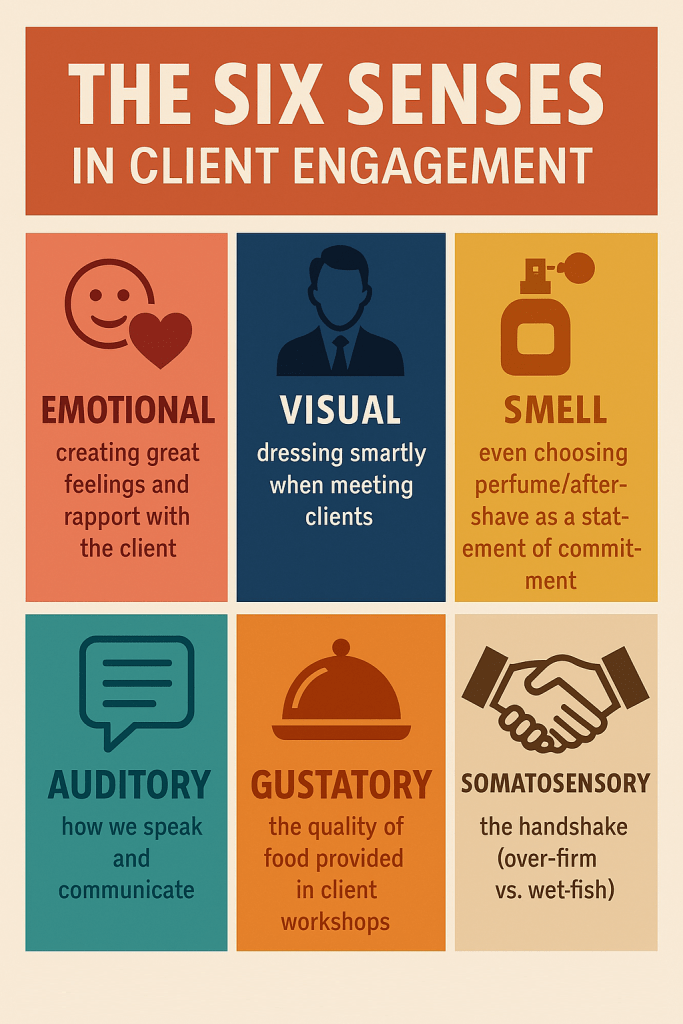
To go the extra mile, Perth’s own Graham Harvey suggests focusing on the customer experience through the customer’s own six senses:
- Emotional – creating great feelings and rapport with the client.
- Visual – dressing smartly when meeting clients.
- Smell – even choosing perfume/after-shave as a statement of commitment (e.g. Singapore Airlines mandates one chosen brand for stewards/stewardesses).
- Auditory – how we speak and communicate.
- Gustatory – the quality of food provided in client workshops.
- Somatosensory – the handshake (over-firm vs. wet-fish).
The aim is to improve every possible interaction with the client. Auditory and visual touchpoints are often digital now — CIOs oversee how service portals, chatbots, and video calls are designed to deliver empathy at scale.
Customer impressions are often formed in seconds — Kahneman’s ‘System 1’ — through tone of voice, handshake, or even scent, long before ‘System 2’ reasoning about price or features comes into play.
Moving Beyond Scripts
Many companies now ask for open responses from customers evaluating the service they’ve received. Instead of sticking to rigid scripts and rules, forward-thinking businesses are training their entire staff — including program and project managers — to appreciate customer concerns and take action as needed.
In today’s VUCA landscape, customer expectations are volatile and ambiguous — meaning service design must be resilient and adaptive, not fixed and scripted.
Resilient programs don’t aim to eliminate failure; they aim to recover quickly. Embedding this mindset into customer service ensures each complaint strengthens, rather than weakens, the organisation.
Resilience, from a CIO’s perspective, goes beyond uptime. It means building customer-facing systems that flex under volatility, remain clear amid ambiguity, and adapt continuously — in short, a VUCA-ready architecture.
Final Reflection:
When did you last think about improving customer service as a project or program manager?

 SquaringTheTriangle
Join the conversation — how do you Square the Triangle?