
SUMMARY
Zhou Enlai, Premier of China, never said ‘Its too early to tell’ when asked about the significance of the French Revolution. He was talking about the student uprisings in France a few years earlier. But as with everything else with the French Revolution, the myth grew and eventually replaced the actual narrative.
The French Revolution is often remembered through dramatic imagery: crowds storming the Bastille, revolutionary tribunals, and the ominous fall of the guillotine. Yet beneath the spectacle lies one of history’s most profound case studies in failed governance, uncontrolled change, and catastrophic decision making.
For project and programme managers, the Revolution provides a surprisingly relevant lens through which to examine leadership, stakeholder management, risk, and transformation. The Revolution was not merely a political event. It was an uncontrolled programme of change executed without clear scope, without aligned stakeholders, and without mechanisms for course correction.
The result was what might be called “guillotine management”: a system where disagreement was eliminated rather than managed, risks were ignored rather than mitigated, and ideology replaced practical leadership.
From a management perspective, the French Revolution offers a powerful set of lessons about vision, communication, governance, and the dangers of unmanaged change.
1. SET A CLEAR VISION
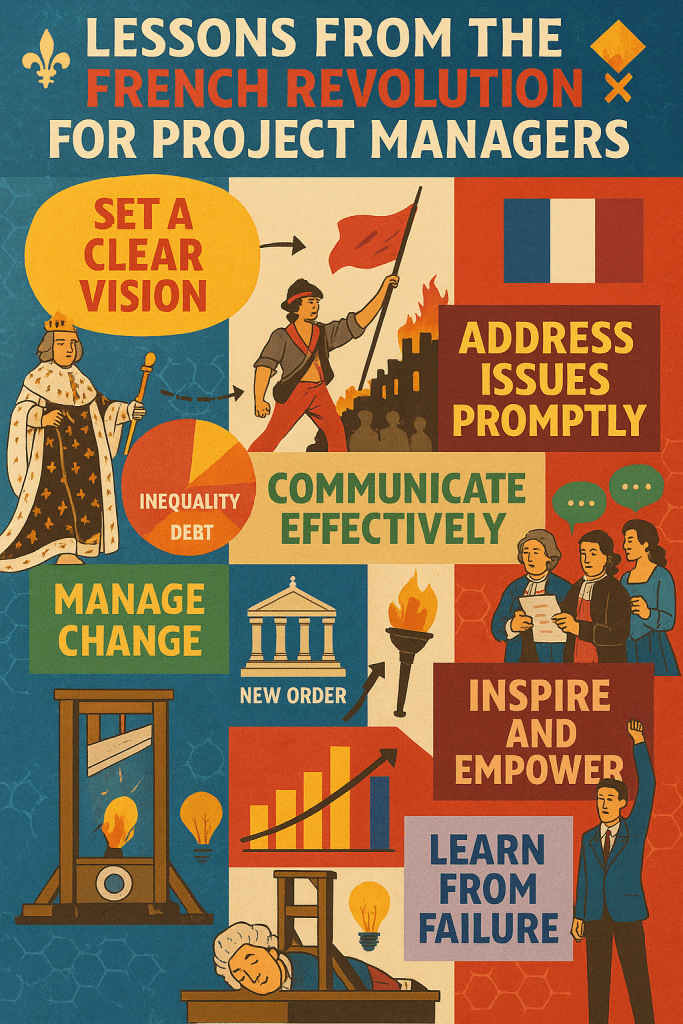
Many revolutions begin with a powerful vision, but the French Revolution quickly lost clarity about what it was trying to achieve. Initially, reformers sought constitutional monarchy, fiscal reform, and representation for the Third Estate. Within a few years, however, the Revolution’s objectives mutated dramatically: monarchy was abolished, the king was executed, radical factions dominated politics, and the country descended into internal violence.
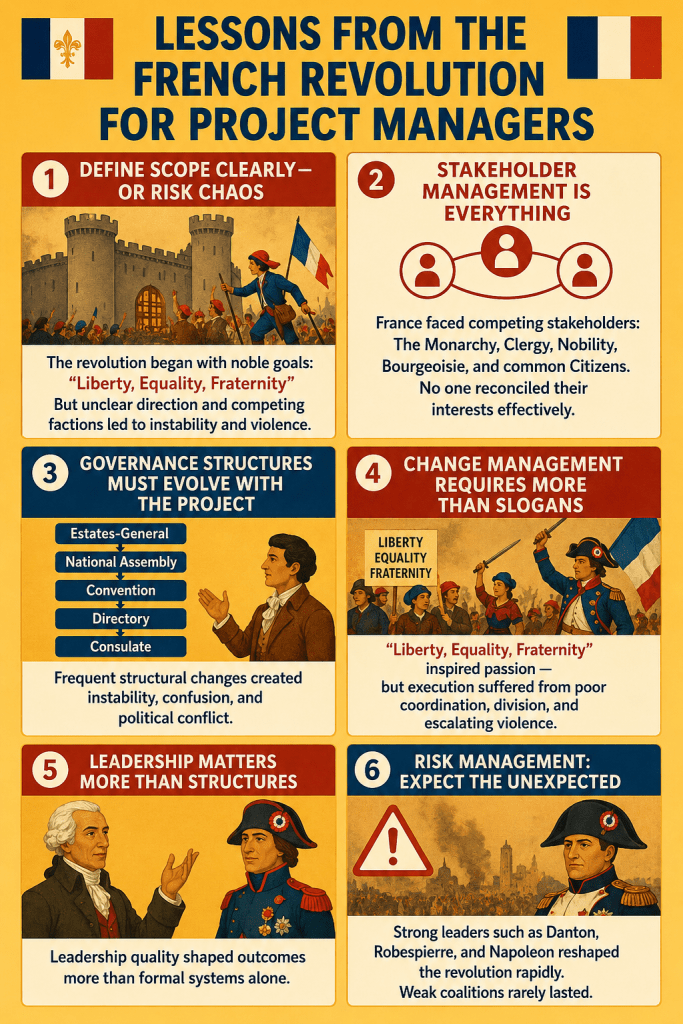
In project terms, the Revolution suffered from catastrophic scope drift. Goals changed constantly, stakeholders pursued conflicting agendas, and no stable governance framework existed to control the direction of change.
Without a clear and stable vision, transformation initiatives become chaotic. Teams lose alignment, priorities shift unpredictably, and decision making becomes reactive rather than strategic.
A programme without a stable vision eventually becomes exactly what the French Revolution became: a struggle for control rather than a pursuit of progress.
2. ADDRESS PROBLEMS EARLY
France entered the Revolution with severe structural problems: massive national debt, inequality between social classes, and widespread food shortages. These issues had been accumulating for decades.
Instead of gradual reform, political paralysis allowed problems to grow until they became explosive.
Projects often fail for the same reason. Early warning signs appear, but organisations delay action. Risks are acknowledged but not addressed. Stakeholders avoid difficult conversations.
Eventually small problems become systemic crises.
When bread shortages and economic distress combined with political instability, public anger exploded. What might have been manageable reforms turned into revolutionary upheaval.
The lesson for project managers is clear: address issues early. Waiting rarely makes problems smaller.
3. COMMUNICATE EFFECTIVELY
Communication during the Revolution became increasingly polarised. Pamphlets, newspapers, and speeches inflamed public opinion rather than clarifying policy.
Revolutionary leaders discovered that the use of ‘outrage’ was more effective in mobilising crowds than careful reasoning.
In modern projects, communication failures produce similar consequences. Stakeholders begin operating on rumours, partial information, and speculation. Misalignment grows and trust collapses.
Effective communication is not simply about broadcasting information. It is about creating shared understanding.
The French Revolution demonstrates what happens when communication becomes propaganda rather than dialogue.
4. MANAGE CHANGE
Large transformations require careful change management.
The French Revolution attempted to redesign almost every institution simultaneously: the Monarchy, the Legal system, the Church, property rights, political representation, the system of measurement, even the calendar.
This was change at an overwhelming scale.
Instead of gradual implementation, reform occurred through sudden and disruptive decrees. Institutions collapsed faster than replacements could be stabilised.
Projects encounter similar dangers when leaders attempt too much change too quickly. Organisations require time to absorb transformation. Culture, systems, and behaviour cannot all be redesigned overnight.
The Revolution shows the dangers of unmanaged change: instability, resistance, and ultimately collapse.
5. INSPIRE AND EMPOWER
Perhaps the most infamous phase of the Revolution was the Reign of Terror. Under leaders such as Robespierre, the revolutionary government executed tens of thousands of people in the name of ‘political purity’.
The guillotine became both symbol and instrument of authority.
But terror proved to be a fragile form of leadership. Fear may produce compliance, but it rarely produces loyalty, creativity, or long term commitment.
In organisations, cultures built on fear produce the same outcome. Teams hide problems, avoid innovation, and focus on self preservation rather than collective success.
The Revolution demonstrates that sustainable leadership must inspire rather than intimidate.
6. LEARN FROM FAILURE
One of the most striking aspects of the Revolution is how rarely leaders paused to learn from previous mistakes. Each political faction blamed its predecessors while repeating the same patterns of intolerance and radicalisation.
Instead of reflection, escalation became the norm.
Successful programmes incorporate continuous learning. Post implementation reviews, lessons learned sessions, and open discussion of mistakes allow organisations to adapt.
The Revolution lacked these mechanisms.
Its leaders replaced one extreme with another until the political system finally stabilised under Napoleon, not through consensus but through a dictatorship.
CONCLUSION
The French Revolution remains one of history’s most powerful examples of how noble aspirations can collapse into destructive outcomes when leadership, governance, and communication fail.
For project and programme managers, the Revolution is not merely a historical curiosity. It is a reminder that large scale transformation requires clarity, discipline, and humility.
Without these elements, initiatives risk devolving into chaos.
And while modern organisations rarely employ literal guillotines, the metaphorical version still exists: projects that eliminate dissent, punish disagreement, and pursue ideology over evidence.
History suggests that such approaches rarely end well.
Editor’s Note:
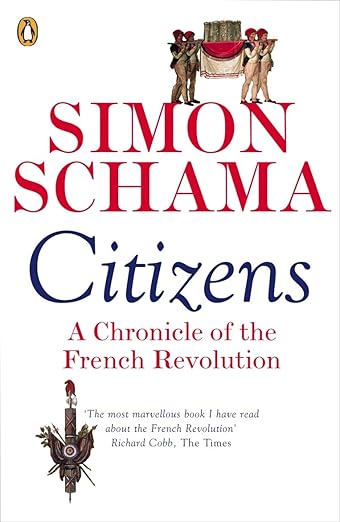
The historian Simon Schama’s monumental work “Citizens: A Chronicle of the French Revolution”, provides one of the clearest portraits of how the Revolution descended from reform into terror.
My review of Citizens on Eclectic Book Review explores this narrative in depth and highlights how the Revolution became less and less a liberation and more a tragedy of escalating extremism.
Further Reading:


Join the conversation — how do you Square the Triangle?